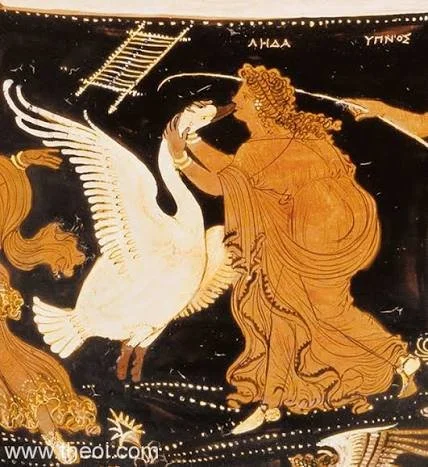
The myth of Leda and the Swan is one of Greek mythology's most famous stories involving Zeus and a mortal woman.
According to the myth, Zeus approached Leda in the form of a swan. The story became especially influential in ancient art and later European painting because of its unusual combination of divine transformation, sexuality, beauty, and deception.
Leda and Zeus
Leda was the wife of Tyndareus, king of Sparta.
Zeus desired her and approached her disguised as a swan.
Ancient sources differ in important details concerning the exact circumstances and the children produced from the encounter.
Some versions connect Leda's offspring with eggs.
Helen of Troy
The most famous child associated with Leda is Helen.
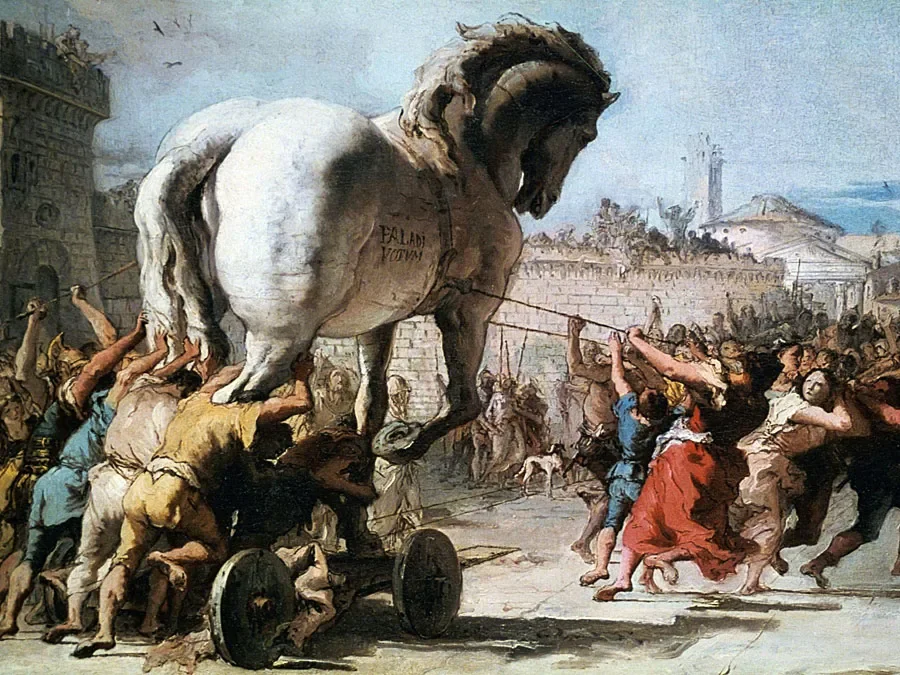
Helen later became the woman whose departure from Sparta with Paris—or, depending on the version, her abduction—helped trigger the Trojan War.
She became known as Helen of Troy.
Her extraordinary beauty is a central feature of the mythology.
Castor and Polydeuces
Leda was also associated with Castor and Polydeuces, known together as the Dioscuri.
Their parentage is complicated.
In one influential tradition, Polydeuces was the son of Zeus while Castor was the son of Tyndareus.
This distinction becomes important because Polydeuces is immortal while Castor is mortal.
Their brotherly relationship eventually leads to one of Greek mythology's most moving stories about immortality and sacrifice.
The Dioscuri
Castor and Polydeuces were famous as horsemen and warriors.
When Castor died, Polydeuces refused to live forever without his brother.
Zeus allowed them to share immortality.
They were eventually associated with the constellation Gemini.
The story transformed their relationship into a symbol of brotherhood.
Leda in Art
The story of Leda and the Swan became extremely popular in Greek and Roman art.
Artists were attracted to the visual contrast between the human woman and divine bird.
However, the story also posed challenges because of its erotic implications.
Ancient artists used sculpture, pottery, mosaics, and other forms to depict the scene.
The myth later became particularly popular during the Renaissance.
Artists including Leonardo da Vinci, Michelangelo, and others explored the subject, although some works survive only through copies or descriptions.
Zeus and Transformation
The myth belongs to a broader pattern in which Zeus changes form to approach mortals.
He becomes:
a bull for Europa
a golden shower for Danaë
a swan for Leda
Transformation allows Zeus to cross boundaries between divine and mortal worlds.
These myths also reflect ancient ideas about the extraordinary power of the gods.
Conclusion
The myth of Leda and the Swan is not simply a romantic tale.
It belongs to a much larger network of Greek stories about Zeus, divine transformation, mortal women, heroic genealogy, and the origins of major mythological figures.
Through Leda, the myth connects directly to Helen of Troy and the Dioscuri.
Its influence extended far beyond ancient Greece, becoming one of the most frequently revisited mythological subjects in Western art.