The Boeotian League was a political and military organization centered on the region of Boeotia in central Greece. Although often overshadowed by Athens and Sparta, Boeotia produced one of the most formidable military powers of the fourth century BCE.
Its history reveals the complexity of Greek politics, where alliances were not simply permanent friendships but constantly changing arrangements shaped by geography, security, economic interests, and competition for regional dominance.
Boeotia's Geography
Boeotia lies immediately north of Attica.
Its geography gave it strategic importance.
The region contained fertile plains and important cities, including:
Thebes
Orchomenus
Thespiae
Plataea
Tanagra
Thebes eventually became the dominant member of the league.
Formation of the League
The Boeotian communities formed a political federation in which member states retained a degree of autonomy while cooperating militarily and politically.
The exact institutional structure changed over time.
The league provided a mechanism for collective defense.
Thebes' Dominance
Although theoretically a federation, Thebes increasingly dominated the Boeotian League.
This created tension.
Smaller communities sometimes preferred independence.
Athens exploited these divisions when possible.
Conflict with Athens
Athens and Boeotia competed for influence in central Greece.
The region was strategically important because it connected northern and southern Greece.
Athens sought influence over Boeotia partly to protect Attica.
Thebes regarded Athenian expansion as a direct threat.
The Persian Wars
Boeotian politics during the Persian invasion were complicated.
Some communities cooperated with Persia.
Others resisted.
Thebes' reputation suffered because of its association with the Persian side.
Nevertheless, Boeotia remained politically important after the Persian Wars.
The Peloponnesian War
During the Peloponnesian War, Thebes generally aligned with Sparta against Athens.
Boeotian forces fought against Athens.
The Battle of Delium in 424 BCE was a major Boeotian victory.
The battle demonstrated the military strength of the region.
The Battle of Delium
Athens attempted to establish a position in Boeotia.
The Boeotians responded with a substantial army.
The Athenians were defeated.
The battle became especially famous because Socrates reportedly participated as a hoplite.
The Theban Revolution
After the Peloponnesian War, Thebes resisted Spartan influence.
Political leaders such as Pelopidas and Epaminondas played major roles.
The Thebans eventually expelled Spartan forces from the city.
The Rise of Theban Power
The fourth century BCE saw Thebes challenge Sparta.
Epaminondas revolutionized Greek tactics.
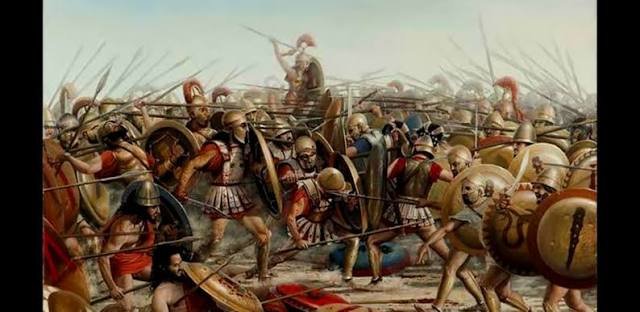
At Leuktra in 371 BCE, Thebes defeated the Spartan army.
The victory transformed Greek politics.
The Sacred Band
Thebes' elite Sacred Band became a symbol of its military strength.
Its soldiers were organized into pairs and trained as an elite formation.
Their defeat at Chaeronea in 338 BCE marked the decline of Theban military independence.
The League's Importance
The Boeotian League demonstrates that ancient Greek politics operated at multiple levels.
There were:
Independent poleis
Regional leagues
Military alliances
Larger hegemonic systems
Greek political organization was therefore far more diverse than the simple Athens-versus-Sparta model suggests.
Decline
The Macedonian victory at Chaeronea weakened Thebes severely.
Later revolts against Macedonian control were suppressed.
Thebes was destroyed by Alexander in 335 BCE after rebelling against Macedonian authority.
Although the city was later rebuilt, its political power never returned to its former level.
Conclusion
The Boeotian League was one of the most important regional political organizations of ancient Greece.
Its rise demonstrates the military potential of federal organization, while its decline illustrates how vulnerable regional alliances became when confronted with larger centralized powers such as Macedon.
Its greatest legacy is perhaps the transformation of Thebes from a secondary Greek power into the dominant military force of mainland Greece for a brief but extraordinary period.