The story of Leander and Hero is one of the most poignant love stories preserved from the mythology and literary tradition of ancient Greece. Unlike many Greek myths dominated by gods, monsters, heroic battles, and royal genealogies, this tale focuses on two ordinary human beings whose love is destroyed by distance, social circumstances, and the unpredictable power of nature.
Hero was a young woman who served as a priestess of Aphrodite at Sestos on the European side of the Hellespont, the narrow waterway connecting the Aegean Sea with the Sea of Marmara. Across the water, at Abydos on the Asian side, lived Leander, a young man who fell deeply in love with her.
The geography of their relationship was central to the story. The Hellespont was narrow enough to cross by boat, yet the lovers were separated by dangerous currents and winds. Their love therefore required Leander to undertake a perilous nightly journey through the water.
Hero of Sestos
Hero's role as a priestess placed her within a religious institution associated with Aphrodite. Her position carried social expectations and restrictions.
The ancient sources do not present Hero simply as an ordinary young woman. Her connection to Aphrodite gives the story an additional dimension because Aphrodite was herself the goddess of desire, sexuality, attraction, and complicated human relationships.
Hero's isolation in her tower or dwelling near the shore becomes one of the defining images of the legend. She is separated from Leander not merely by geography but by the social and religious circumstances surrounding her life.
Leander of Abydos
Leander was a young man from Abydos who encountered Hero and became passionately attached to her.
The two fell in love, but the distance separating them made their relationship difficult.
Leander eventually promised to swim across the Hellespont each night to reach Hero. She agreed to guide him by placing a lamp or torch at the top of her tower.
The light would serve as a beacon.
It transformed their love into a ritual of nightly risk.
The Hellespont as an Obstacle
The geography of the Hellespont is crucial to understanding why the myth was so powerful.
The waterway is relatively narrow compared with open-sea crossings, but its currents can be strong and unpredictable. Ancient sailors understood the danger of the strait.
Leander's nightly swimming therefore represents both devotion and recklessness.
Every journey required him to place his life at risk.
The physical act of crossing the water becomes a metaphor for the lengths to which lovers may go for one another.
The Lamp of Hero
Hero's lamp is one of the most recognizable symbols associated with the story.
From her position on shore, Hero would light a beacon to guide Leander.
The lamp represented safety, love, and hope.
As long as the flame remained visible, Leander could orient himself in the darkness.
The story therefore creates a fragile connection between the lovers. Their relationship depends upon a small flame surviving against darkness, wind, and distance.
This symbolism becomes especially tragic near the end.
Love and Secrecy
The relationship between Hero and Leander was not portrayed as a conventional public marriage.
Their meetings occurred at night and in secrecy.
This secrecy contributes to the emotional tension of the narrative. The lovers were able to create a private world that existed outside ordinary social structures.
Yet that private world was extremely vulnerable.
There was no established household, no public protection, and no stable future guaranteed to them.
Their relationship existed almost entirely through repeated acts of trust.
Leander's Dangerous Journey
Each night, Leander entered the water.
He swam toward the light while Hero waited on the opposite shore.
When he arrived, they spent the night together.
Before dawn, Leander returned across the Hellespont.
The repetition of the journey is essential. It transforms the act from a single heroic achievement into a sustained demonstration of devotion.
Leander did not merely risk his life once.
He repeatedly accepted the same danger.
The Storm
The tragedy occurs when the weather changes.
One night, the winds become violent. The water grows dangerous, and the flame guiding Leander is extinguished.
Without the light, Leander loses his guide.
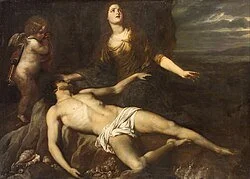
He struggles against the sea but eventually drowns.
Hero waits for him.
When his body is carried ashore, she realizes what has happened.
The myth reaches its emotional climax through the contrast between expectation and silence.
She had expected him to arrive.
Instead, the sea returns his body.
Hero's Death
Unable to endure the loss, Hero throws herself from the tower and dies.
The deaths of both lovers transform the story from a romance into a tragedy.
Their inability to survive separation becomes the central lesson of the myth.
Love, however powerful, cannot always overcome the physical and social forces surrounding human beings.
The Meaning of the Sea
The sea functions almost like an antagonist.
It separates the lovers, tests Leander's courage, extinguishes their hopes, and ultimately causes their deaths.
Yet the sea is not portrayed as morally evil.
Instead, it represents nature's indifference.
Leander's love may be sincere, but the sea does not respond to human emotion.
This creates a distinctly tragic quality.
The Role of Aphrodite
Because Hero is associated with Aphrodite, the goddess of love remains an implicit presence throughout the story.
The myth can therefore be interpreted as a reflection on the double nature of love.
Love creates extraordinary courage and emotional intensity, but it can also expose individuals to vulnerability.
Leander's devotion gives him the courage to cross dangerous waters.
That same devotion ultimately contributes to his death.
The Myth in Ancient Literature
The most famous surviving ancient literary treatment of the story is associated with the Greek poet Musaeus, traditionally credited with the late antique poem Hero and Leander.
The story was also known through references and artistic traditions.
Its survival demonstrates the long-standing appeal of tragic romance in Greek literature.
Unlike heroic myths in which the protagonist wins glory through combat, Leander's heroism is emotional rather than military.
His challenge is not an army or monster.
It is distance.
The Symbolism of the Lamp
The lamp has become one of the strongest symbols associated with the story.
It can be interpreted in several ways.
It represents guidance because it shows Leander the way.
It represents hope because its continued existence means Hero is waiting.
It represents love because Hero lights it specifically for him.
And it represents fragility because a single gust of wind can extinguish it.
The flame therefore mirrors the relationship itself: precious, powerful, and vulnerable.
Love Against Geography
The story also demonstrates how geography could shape ancient imagination.
The Hellespont was not merely a physical location. It was a boundary between Europe and Asia and an important maritime passage.
By placing the lovers on opposite sides, the myth transforms a real geographical feature into a symbol of separation.
Their relationship literally crosses a continental boundary.
Heroism Without Warfare
Greek mythology frequently celebrates warriors such as Achilles, Heracles, Theseus, and Perseus.
Leander represents a different type of heroic figure.
His defining quality is persistence.
He repeatedly performs a dangerous act because of love.
Although his actions ultimately fail, the myth treats his devotion as emotionally heroic.
His courage is therefore not measured by battlefield victories but by willingness to confront fear.
The Tragic Structure
The narrative follows a classic tragic pattern.
First comes attraction.
Then separation creates difficulty.
The lovers establish a solution.
The solution works repeatedly.
The audience becomes aware that the arrangement is fragile.
Then an unexpected natural event destroys it.
The deaths of the lovers complete the tragedy.
This structure has helped make the myth remarkably adaptable to later literature and art.
The Legacy of Leander and Hero
The story continued to influence European literature, painting, poetry, and drama long after antiquity.
The image of a lover swimming across dangerous water became a metaphor for devotion and romantic determination.
The myth also inspired later writers who were interested in themes of forbidden love, sacrifice, separation, and tragic fate.
Its enduring appeal comes partly from its simplicity.
There are no complicated genealogies.
There is no enormous war.
There is no supernatural monster.
There are simply two people who love each other and a dangerous body of water between them.
Conclusion
The myth of Leander and Hero is ultimately a story about love confronting forces beyond human control.
Leander's nightly crossings demonstrate extraordinary devotion, while Hero's lamp symbolizes the hope that connects the two lovers across the darkness. Yet the very system that allows them to meet is fragile. When the lamp is extinguished and the sea becomes hostile, their private world collapses.
The tragedy is powerful because neither lover is defeated by a villain. They are defeated by distance, weather, and mortality.
Their story therefore occupies a distinctive place within Greek mythology: a tale in which the greatest danger is not a monster or a warrior but the uncontrollable world itself.
The Hellespont remains the enduring symbol of that separation—a narrow stretch of water that, in the imagination of the myth, becomes an immense boundary between love and loss.