The story of Medea is among the darkest and most psychologically complex narratives in Greek mythology. She is simultaneously portrayed as a princess, a sorceress, a devoted lover, a betrayed wife, a mother, and an agent of devastating revenge. Her story is closely connected to Jason and the Argonauts, but its most famous episode occurs after Jason abandons her in Corinth.
Medea's revenge is particularly significant because Greek mythology often presents women as victims of decisions made by male heroes and rulers. Medea, however, refuses to accept a passive role. She responds to betrayal through calculated and terrible action.
The tragedy raises difficult questions about love, marriage, exile, gender, political power, motherhood, and revenge.
Medea's Origins
Medea was the daughter of Aeëtes, king of Colchis, a distant land located at the eastern end of the Black Sea in Greek geographical imagination.
Colchis was famous as the destination of Jason and the Argonauts, who traveled there in search of the Golden Fleece.
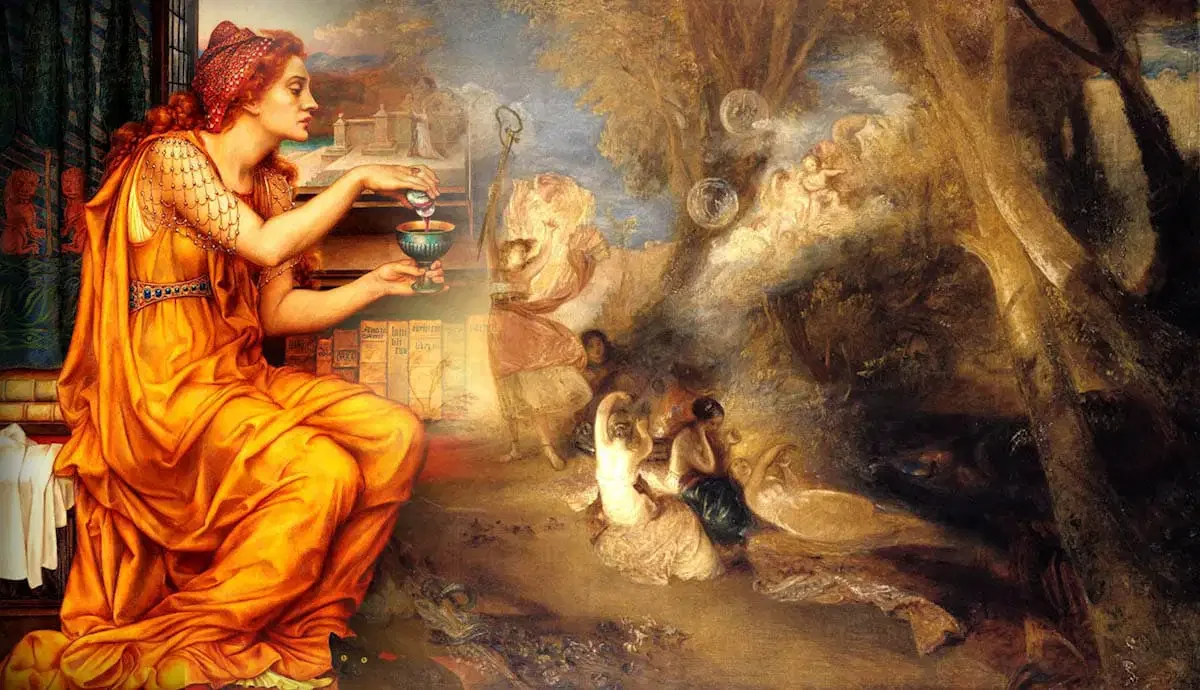
Medea was associated with supernatural knowledge and magic. Her identity as a practitioner of pharmakeia—the use of magical substances, potions, and ritual knowledge—distinguished her from ordinary women in Greek literature.
Jason and the Golden Fleece
Jason arrived in Colchis as leader of the Argonauts.
King Aeëtes did not willingly surrender the Golden Fleece. Instead, he imposed seemingly impossible tasks upon Jason.
Jason needed to yoke fire-breathing bulls, plow a field, sow it with dragon's teeth, and defeat the warriors that emerged from the ground.
Medea fell in love with Jason and decided to help him.
Her knowledge of magic allowed Jason to survive the challenges.
She provided him with protective substances and instructions that enabled him to complete the tasks.
Medea's Betrayal of Her Family
Medea's assistance came at an enormous personal cost.
She betrayed her father and homeland.
She abandoned her family and fled with Jason.
In some versions of the myth, her actions during the escape became increasingly violent.
Her decision illustrates the extraordinary power that love held over her.
Jason was not merely a romantic partner. For Medea, he became the reason she severed her connection to her homeland.
Marriage and Exile
Medea and Jason eventually arrived in Greece and established a life together.
They had children.
For a time, Medea appeared to have gained what she had sacrificed everything to obtain: a husband, family, and place in Greek society.
But her position remained precarious.
She was a foreign woman living in a Greek city.
Her identity as an outsider would later become politically significant.
Jason's New Marriage
The central betrayal occurs when Jason decides to marry another woman, usually identified as Creusa, daughter of King Creon of Corinth.
Jason attempts to justify the marriage as politically advantageous.
He argues that the new marriage will improve his family's position and provide greater security for their children.
From Medea's perspective, however, Jason has betrayed the woman who sacrificed everything for him.
She reminds him that she abandoned her father, homeland, and family because of their relationship.
Her anger is therefore not simply jealousy.
It is a response to betrayal and displacement.
Medea as an Exile
King Creon fears Medea.
He recognizes that she is intelligent, powerful, and capable of magic.
He therefore orders her to leave Corinth.
This decision intensifies the tragedy.
Medea is not only losing her husband; she is also losing her home.
She faces exile with her children and has no obvious place to go.
Yet Medea persuades Creon to allow her one additional day.
That single day gives her enough time to plan her revenge.
The Poisoned Gifts
Medea prepares gifts for Jason's new bride.
They include a beautiful robe and a golden crown.
The objects appear to be symbols of generosity and reconciliation.
Instead, they are poisoned.
When Creusa puts them on, the magical substances cause her to suffer a horrifying death.
The gifts therefore become instruments of destruction.
Their beauty conceals their purpose.
The Death of Creon
Creon attempts to rescue his daughter.
He embraces her and becomes affected by the poison.
He dies alongside her.
Medea's revenge has now destroyed not only Jason's bride but also the king who expelled her.
Yet her most terrible decision remains.
The Murder of the Children
Medea decides to kill her own children.
This is the most disturbing element of the story and the feature that has generated centuries of debate.
Her motivation is complex.
She knows that Jason will suffer profoundly if his children die.
She also fears that her enemies might harm them.
In Euripides' tragedy, Medea struggles internally with her maternal love and desire for revenge.
She loves her children.
But she ultimately chooses to kill them.
The decision transforms her revenge into an act of horrifying self-destruction.
Why Medea Kills Her Children
The children's deaths serve several functions within the tragedy.
First, they punish Jason.
Second, they prevent Jason from continuing his family line through the children.
Third, they demonstrate the extremity of Medea's anger.
Fourth, they reveal the destructive consequences of a society in which women can possess limited legal and political power.
Medea cannot defeat Jason through ordinary political means.
Instead, she uses the very family structure that he values against him.
Jason's Despair
Jason arrives too late.
He discovers that his new wife and children are dead.
Medea confronts him from a position he cannot reach, often depicted in a chariot provided by the sun god Helios.
Jason is devastated.
The final confrontation is therefore one between two people whose relationship has been completely destroyed.
Medea has won her revenge, but she has also destroyed herself.
Medea and the Question of Justice
The myth creates an uncomfortable distinction between justice and revenge.
Medea has been genuinely wronged.
Jason has betrayed her.
Yet the punishment she chooses is vastly disproportionate.
The tragedy therefore refuses to provide a simple moral answer.
Medea is both victim and perpetrator.
She suffers injustice and commits horrific violence.
This ambiguity is one of the reasons the story remains so powerful.
Medea and Women in Ancient Greek Society
The story also provides insight into ancient Greek concerns about marriage and gender.
In classical Athens, women generally possessed less political and legal autonomy than men.
Marriage could be closely connected to family interests, inheritance, and social status.
Medea's position as a foreign woman intensifies her vulnerability.
She has no powerful male family network in Corinth.
Her identity as an outsider makes her dependent upon Jason.
When he abandons her, she loses the social protection that marriage had provided.
Medea as a Foreign Woman
Her foreign identity is particularly important.
Greek literature often represented foreign peoples as culturally different or threatening.
Medea embodies that anxiety.
She is intelligent and sophisticated, yet she is also associated with magical knowledge and the distant world of Colchis.
Her status as an outsider makes her both fascinating and dangerous.
Magic and Female Power
Medea's knowledge of magic represents an alternative form of power.
She does not command an army.
She does not rule a city.
She does not possess conventional political authority.
Instead, she possesses knowledge.
Her ability to manipulate medicines, poisons, and supernatural forces allows her to overcome people with greater formal power.
This makes her an unusual figure in Greek mythology.
Euripides' Medea
The most influential literary version is Euripides' tragedy Medea, first performed in Athens in 431 BCE.
Euripides presents Medea as intellectually formidable and emotionally complex.
She speaks eloquently about the difficulties women face in marriage and the vulnerability of foreigners.
The play does not portray her simply as a monster.
Instead, the audience is encouraged to understand her suffering even while condemning her actions.
This psychological complexity is one of the major achievements of the tragedy.
The Sun Chariot
At the conclusion, Medea escapes in a chariot associated with Helios, the sun god.
This supernatural escape is symbolically significant.
Jason cannot punish her.
She remains beyond his reach.
The gods' connection to Medea also complicates the moral structure of the story.
Her escape does not necessarily mean that the gods approve of her actions. Instead, it reinforces the mythological ambiguity surrounding her character.
The Legacy of Medea
Medea became one of the most influential tragic figures in Western literature.
Later writers, dramatists, composers, filmmakers, and psychologists have returned repeatedly to her story.
She has been interpreted as:
a betrayed wife,
a symbol of female anger,
a foreign outsider,
a powerful sorceress,
a tragic mother,
a representation of destructive passion,
and a warning about the consequences of betrayal.
No single interpretation fully explains her.
Conclusion
The Tale of Medea’s Revenge remains powerful because it refuses to make suffering simple.
Medea is wronged by Jason, but her response creates an even greater catastrophe. Her intelligence becomes an instrument of destruction, her love becomes hatred, and her role as mother becomes entangled with revenge.
The tragedy ultimately demonstrates how betrayal can transform relationships into conflicts over identity, power, and dignity.
Medea's story is not merely about a jealous woman taking revenge. It is about what happens when a person who has sacrificed everything for another discovers that the promises on which her entire life depended can be discarded.
That is what makes Medea one of the most enduring and unsettling figures in Greek mythology.