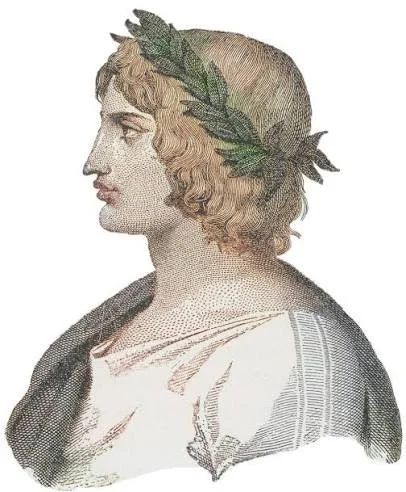
The laurel wreath is one of the most recognizable symbols associated with ancient Greece. It has become a modern emblem of victory, achievement, scholarship, and artistic excellence, yet its origins lie in a complex combination of mythology, religion, ritual, and social custom.
The plant itself, the laurel or daphne, was closely associated with Apollo. According to Greek mythology, the connection originated in the tragic story of Daphne, a nymph who was transformed into a laurel tree while attempting to escape Apollo.
From this myth developed one of the most enduring symbols of ancient Mediterranean culture.
Daphne and Apollo
Daphne was a beautiful nymph associated with nature and the wilderness.
Apollo, one of the most important Olympian gods, became attracted to her.
The circumstances of his love vary among traditions, but the basic narrative is that Daphne did not return his affection.
She desired to preserve her independence and avoid Apollo's pursuit.
When Apollo attempted to catch her, Daphne called upon divine assistance.
Her father, usually identified as the river god Peneus, transformed her into a laurel tree.
The Transformation
The transformation represents both escape and loss.
Daphne avoids Apollo, but she does so by surrendering her human form.
Apollo, confronted with the tree, declares the laurel sacred to himself.
He adopts its leaves as a symbol of remembrance.
The plant therefore becomes permanently associated with Apollo.
Apollo and the Laurel
Apollo was a god of music, poetry, prophecy, medicine, and intellectual excellence.
Because the laurel became sacred to him, it naturally acquired associations with artistic and intellectual accomplishment.
The symbolism expanded beyond the original myth.
The wreath eventually represented excellence in competitions and achievement in fields connected with Apollo.
The Pythian Games
One of the most important contexts for the laurel was the Pythian Games at Delphi.
The games were held in honor of Apollo.
Athletic competitions were included, but the festival was especially distinguished by contests involving music, poetry, and artistic performance.
Victors received prizes associated with Apollo.
The laurel became an important symbol of success.
Laurel and Victory
The wreath represented achievement because it was physically placed upon the head of the victor.
This gesture transformed abstract success into visible honor.
A wreath could therefore communicate social status without words.
A person wearing one had demonstrated excellence in competition.
Why a Wreath?
Wreaths had practical advantages.
They were inexpensive compared with precious-metal crowns and could be made from locally available plants.
Yet their symbolic value could be enormous.
Different plants were associated with different gods, rituals, and forms of achievement.
The laurel's association with Apollo gave it special prestige.
Laurel in Religious Ritual
Laurel was also used in religious contexts.
Because it was sacred to Apollo, branches could appear in rituals connected with his worship.
The plant could therefore signify purity, divine favor, and sacred authority.
At Delphi, where Apollo's oracle operated, the laurel was especially important.
The Oracle at Delphi
The sanctuary of Delphi was one of the most influential religious centers in the ancient Greek world.
The Pythia, the priestess who delivered Apollo's prophetic responses, operated within a sacred environment in which the laurel held symbolic significance.
Ancient traditions connected the plant with prophetic practices.
The precise historical details of how laurel was used in every Delphic ritual remain uncertain, but its association with Apollo and Delphi is firmly established in Greek cultural tradition.
Laurel and Poetic Achievement
Because Apollo was associated with poetry and music, laurel became linked with literary achievement.
Poets could be metaphorically described as receiving the laurel.
This tradition eventually influenced the concept of the “laureate”—a person formally honored for literary or artistic achievement.
From Greece to Rome
The symbolism of the laurel continued into Roman culture.
Roman generals and political leaders used laurel as a symbol of triumph.
Triumphal processions incorporated elaborate displays of military success.
The laurel therefore developed from a specifically Apollonian symbol into a broader emblem of victory.
Laurel and Political Power
Roman rulers also adopted laurel imagery.
Emperors could be depicted wearing laurel wreaths on coins and sculptures.
The wreath therefore became associated not only with athletic and artistic achievement but also with political authority and military success.
This illustrates how symbols can evolve as cultures adopt and reinterpret them.
Laurel and the Concept of Glory
The wreath's deeper meaning lies in the Greek concept of honor.
Ancient Greek societies placed enormous importance on reputation and public recognition.
Athletic victories, military accomplishments, poetic success, and civic achievements could increase an individual's kleos—lasting fame or glory.
The wreath represented that public recognition.
The Laurel as an Eternal Symbol
Unlike gold or silver, a plant is organic and temporary.
Its leaves eventually wither.
This creates an interesting contrast.
The wreath is physically temporary but symbolically permanent.
The person may wear it for only a short time, but the achievement it represents is intended to survive in collective memory.
Modern Uses
The laurel wreath continues to appear in modern medals, academic institutions, military insignia, logos, and cultural imagery.
It often represents:
victory,
excellence,
scholarship,
artistic achievement,
leadership,
peace,
and honor.
Many modern uses are ultimately connected to the symbolic traditions established in the ancient Mediterranean.
Conclusion
The origin of the laurel wreath is rooted in the myth of Daphne and Apollo, but its meaning grew far beyond that original story.
The transformation of Daphne into a laurel tree created a sacred association with Apollo. Through Apollo's connection with music, poetry, prophecy, and competition, the laurel became a symbol of achievement.
At Delphi and the Pythian Games, it represented honor and victory. Later, Roman society expanded its symbolism into military and political triumph.
Today, the laurel wreath remains recognizable because its basic message is universal: excellence deserves recognition.
What began in Greek mythology as the story of a nymph transformed into a tree eventually became one of the world's most enduring visual symbols of accomplishment.