The story of Orion and the Scorpion is one of the most famous constellation myths associated with ancient Greek astronomy and mythology. Orion was remembered as an enormous and extraordinarily skilled hunter, while the scorpion became the creature responsible for his death in one of the best-known versions of his legend.
The story is particularly fascinating because Greek mythology did not treat the stars merely as astronomical objects. Constellations were woven into stories that explained their identities, relationships, and positions in the night sky.
Orion and Scorpius became permanently separated in the heavens, providing an elegant mythological explanation for their apparent movement across the sky.
Orion the Great Hunter
Orion was generally described as a giant hunter.
His parentage varies among ancient sources.
In one tradition, he was the son of Poseidon, which gave him unusual abilities connected with the sea and allowed him to walk upon water.
In another story, Orion's conception involved Zeus, Hermes, and Poseidon.
These variations demonstrate the flexibility of Greek mythology.
Different communities and authors could preserve different genealogies while maintaining the basic identity of Orion as a magnificent hunter.
Orion's Hunting Ability
Orion's defining characteristic was his hunting skill.
He was frequently represented carrying a weapon and accompanied by hunting animals.
His enormous size made him visually appropriate for a prominent constellation.
Ancient observers saw recognizable patterns of stars and transformed them into a legendary figure.
The constellation's distinctive arrangement helped maintain Orion's identity across centuries.
Orion and Artemis
One important version of the myth connects Orion with Artemis, goddess of the hunt.
Because both shared an association with hunting, their relationship became particularly significant.
Some versions present them as companions or potential lovers.
Others emphasize Artemis' role in Orion's death.
The different traditions demonstrate how mythology could adapt to different religious and literary interests.
The Scorpion
The scorpion appears in one of the most famous explanations of Orion's death.
According to the myth, Orion became excessively confident in his hunting abilities.
In some versions, he claimed that he could kill every animal on Earth.
Such a statement represented dangerous arrogance.
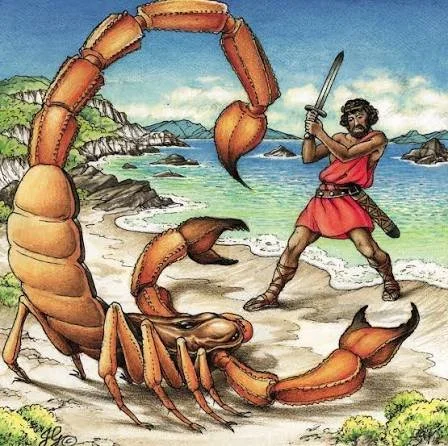
The Earth goddess Gaia, or in some versions another divine figure, sent a gigantic scorpion against him.
The creature was able to defeat the mighty hunter.
The Meaning of Hubris
Greek mythology repeatedly warns against excessive pride, or hubris.
Orion's boast fits this pattern.
A mortal or semi-divine figure may possess extraordinary abilities, but claiming superiority over all living things challenges the boundaries of human existence.
The scorpion therefore functions as a corrective force.
Orion may be the greatest hunter, but he is not invincible.
Orion's Death
The scorpion attacks Orion and kills him with its venomous sting.
The death of such a powerful hunter at the hands of a comparatively small creature creates an ironic contrast.
Physical size does not guarantee victory.
The scorpion's weapon is its poison, not strength.
The myth therefore emphasizes that unexpected dangers can defeat even the most powerful individuals.
Artemis and Orion's Death
Another tradition states that Artemis accidentally killed Orion.
In this version, Orion was swimming in the sea while Artemis was challenged or deceived into shooting at a distant target.
She struck Orion without realizing his identity.
After discovering what she had done, she placed him among the stars.
The scorpion tradition provides a different explanation, demonstrating how Greek mythology frequently offered multiple competing versions of the same story.
Orion in the Night Sky
The constellation Orion is one of the most recognizable star patterns in the northern and equatorial skies.
Its prominent stars include Betelgeuse and Rigel.
The three stars of Orion's Belt are particularly distinctive.
Ancient observers recognized this pattern and connected it to the legendary hunter.
The constellation became part of a larger mythological landscape in the sky.
Scorpius in the Heavens
Scorpius is also an easily recognizable constellation.
Its curved arrangement of stars resembles the shape of a scorpion.
In Greek mythology, its placement opposite Orion created a dramatic celestial relationship.
As one constellation rises, the other eventually sets.
The Greeks interpreted this apparent avoidance as evidence that Orion continued to flee from the scorpion even after death.
Myth Explaining Astronomy
This relationship illustrates how mythology could function as a cultural framework for understanding celestial phenomena.
Ancient Greeks did not possess modern astrophysics, but they carefully observed the heavens.
They tracked stars for navigation, calendrical purposes, religious rituals, and agricultural timing.
Myth provided narratives that made these patterns memorable.
Orion and Seasonal Change
The appearance of Orion in the night sky was associated with particular seasons.
The constellation's visibility therefore had practical significance.
Ancient agricultural and maritime communities paid attention to stellar cycles.
Orion was consequently both a mythological character and a recognizable astronomical marker.
Orion in Greek Literature
Orion appears in several ancient literary traditions.
Homer and Hesiod refer to him in connection with the heavens.
The Odyssey describes Orion as a famous hunter visible among the stars.
Later authors expanded his mythology.
His popularity demonstrates the close relationship between epic literature and astronomical observation.
The Scorpion as Divine Justice
The scorpion can also be interpreted as an instrument of divine correction.
It is not necessarily a villain.
Its purpose is to defeat Orion's excessive confidence.
The creature represents a natural limit.
Even the strongest hunter has an enemy.
This idea appears throughout Greek mythology.
Heroes often achieve extraordinary accomplishments but eventually encounter mortality or divine judgment.
The Paradox of Orion's Immortality
Although Orion dies, he becomes immortalized as a constellation.
This creates an important mythological paradox.
His physical life ends, but his identity becomes permanent.
The stars preserve his image.
Greek mythology frequently used transformation into stars as a form of posthumous honor or explanation.
The Cultural Importance of Constellations
Constellations were not simply scientific categories in the modern sense.
They were part of Greek cultural memory.
Stories helped people remember the sky.
Children could learn constellations through mythology, while sailors could use their positions for orientation.
Astronomy and storytelling therefore existed alongside one another.
The Legacy of Orion and Scorpius
The Orion myth remains influential because it connects several subjects at once:
mythology,
astronomy,
seasonal observation,
navigation,
religious belief,
and ideas about human pride.
The constellations remain visible today, although modern astronomy interprets them differently.
Their scientific identities as arrangements of stars coexist with the ancient stories that gave them cultural meaning.
Conclusion
The story of Orion and the Scorpion demonstrates the extraordinary ability of Greek mythology to transform the natural world into narrative.
Orion represents strength, hunting skill, ambition, and pride.
The scorpion represents an unexpected force capable of defeating even the greatest hunter.
Their placement in the heavens transformed a tragic death into an eternal celestial story.
Whenever Orion appears in the night sky, the ancient myth remains embedded within human cultural memory: a reminder that even extraordinary power has limits, and that the stars themselves can become monuments to the stories people tell about courage, arrogance, death, and immortality.