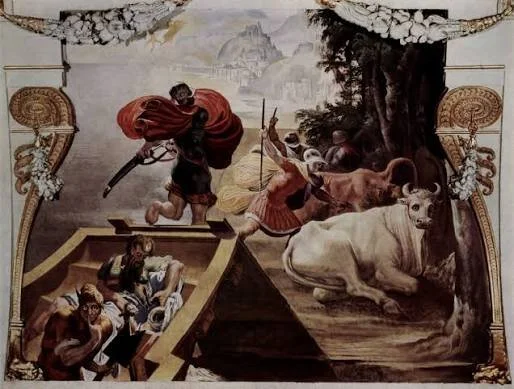
The sacred cattle of Helios are among the most memorable elements of Homer's Odyssey. Their story occurs during Odysseus' disastrous return journey from Troy and serves as one of the clearest examples of the relationship between divine law, human temptation, and punishment in Greek epic.
The cattle belonged to Helios, the sun god. They were kept on the island of Thrinacia and were considered sacred. Odysseus and his companions were warned not to harm them.
The warning was explicit.
Yet hunger, exhaustion, and desperation eventually overcame the sailors' restraint.
Their decision to slaughter the sacred animals became the final major disaster before Odysseus reached Ithaca.
Helios, the Sun God
Helios was the divine personification of the sun.
In Greek artistic and literary traditions, he was imagined as traveling across the sky in a radiant chariot.
Because the sun sees the world from above, Helios was sometimes associated with observation and knowledge.
Nothing happening beneath the heavens was completely hidden from him.
This characteristic becomes important when his sacred cattle are slaughtered.
The Herds of Thrinacia
According to the Odyssey, Helios possessed magnificent cattle and sheep on the island of Thrinacia.
The animals were extraordinary in their abundance and beauty.
They were not ordinary livestock.
Their sacred status meant that humans were forbidden from killing or eating them.
The animals represented a boundary between human need and divine property.
Odysseus' Warning
Odysseus had been warned about the island.
The prophet Tiresias had already provided him with instructions concerning his journey.
Circe later reinforced the warning.
The sailors were told to avoid the cattle of Helios.
If they left the animals untouched, they might survive.
If they harmed them, disaster would follow.
The instructions therefore created a clear moral choice.
Arrival at Thrinacia
After a long period of suffering, Odysseus and his men reached Thrinacia.
Unfortunately, the weather prevented them from immediately continuing their voyage.
They were forced to remain on the island.
Their food supplies gradually disappeared.
Hunger became increasingly severe.
Odysseus ordered his companions not to touch the cattle.
He understood the danger.
The Sailors' Hunger
The crew eventually reached a desperate state.
Odysseus had gone away from the camp to pray.
While he was absent, Eurylochus argued that starvation was worse than death.
He suggested that the men should sacrifice the cattle to the gods and ask forgiveness.
His argument was based on necessity.
The sailors believed that dying from hunger would be inevitable unless they acted.
This moment demonstrates one of the recurring tensions in Greek mythology: whether desperate circumstances can justify breaking divine commands.
The Slaughter
The men captured some of the cattle.
They sacrificed them and ate the meat.
The act violated the explicit prohibition.
According to Homer, the gods responded with signs indicating their displeasure.
The hides moved, and the meat appeared to behave unnaturally.
These omens demonstrated that the animals were not ordinary.
The sailors nevertheless continued.
Helios Learns of the Crime
Helios demanded that the other gods punish Odysseus' companions.
He threatened to descend into the underworld if justice was not carried out.
The sun itself was therefore placed at the center of the divine dispute.
The death of sacred animals was not treated as a minor offense.
It threatened the proper relationship between gods and mortals.
Zeus' Punishment
Eventually Zeus destroyed Odysseus' ship with a thunderbolt.
The entire crew died.
Only Odysseus survived.
His survival was not presented as a reward for complete innocence. Rather, Odysseus had attempted to restrain his companions and had not personally participated in the slaughter.
The punishment therefore fell primarily upon those who had violated the prohibition.
The Meaning of Sacred Animals
Sacred animals were important in many ancient religious traditions.
Animals could be associated with particular gods and sanctuaries.
Their protection reflected the broader principle that humans were expected to recognize boundaries between sacred and ordinary space.
The cattle of Helios therefore symbolize divine ownership.
To kill them was to treat something belonging to a god as if it were ordinary property.
Hunger Versus Religious Law
The story is particularly interesting because the sailors' motivation is understandable.
They are starving.
Their decision is therefore not presented as simple cruelty.
They are desperate.
Yet Greek religious thought generally placed obligations to the gods above immediate personal survival.
The myth consequently asks whether human desperation can excuse sacrilege.
Its answer is severe.
Odysseus as Leader
The episode also reflects the difficulties of leadership.
Odysseus knows the correct course of action.
He gives his men explicit instructions.
But he cannot control them completely.
Their independent decision ultimately destroys the entire expedition.
This illustrates an important aspect of epic leadership: a commander can provide wisdom and warnings, but the actions of followers can still determine collective survival.
Eurylochus and Responsibility
Eurylochus plays an important role in the episode.
He persuades the others that killing the cattle is necessary.
His argument is essentially practical.
The men cannot survive indefinitely without food.
Yet his reasoning ignores the supernatural consequences of violating the divine prohibition.
The story therefore contrasts human practicality with religious obligation.
The Cattle as a Test
The cattle function as a moral test.
The sailors have already endured enormous hardships.
They have survived storms, monsters, warfare, and supernatural dangers.
Yet their final challenge is internal.
Can they control themselves when they are starving?
The answer is no.
The greatest danger is therefore not always an external monster.
Sometimes it is human weakness.
The Broader Theme of the Odyssey
The sacred cattle episode fits one of the major themes of the Odyssey: the consequences of failing to exercise self-control.
The Cyclops episode demonstrates the dangers of uncontrolled curiosity and pride.
The Lotus-Eaters demonstrate the temptation to abandon one's responsibilities.
The Sirens represent irresistible desire.
The cattle of Helios represent the inability to restrain appetite.
Each episode tests Odysseus and his companions differently.
The Relationship Between Humans and Gods
The episode also illustrates the unequal relationship between mortals and gods.
Humans possess freedom of choice, but divine power establishes consequences.
The sailors are not forced to kill the cattle.
They choose to do so.
Their punishment therefore follows their decision.
This pattern appears throughout Greek mythology.
Symbolism of the Sun
Helios' identity as the sun adds another layer of meaning.
The sun illuminates everything.
The slaughter of his cattle cannot remain hidden.
Even though the sailors commit the act when Odysseus is absent, divine knowledge eventually exposes them.
The sun therefore becomes a symbol of unavoidable observation.
The Fate of Odysseus
Odysseus survives the destruction of the ship.
He is left alone at sea and eventually reaches the island of Calypso.
His companions are gone.
The slaughter of the cattle therefore marks the final destruction of his crew.
From this point onward, his journey becomes increasingly solitary.
Conclusion
The Sacred Cows of Helios are more than a strange episode in the Odyssey. They represent a fundamental conflict between human survival and divine command.
The sailors are hungry and desperate, but they have been warned repeatedly.
Their choice demonstrates how easily desperation can overcome discipline.
For Homer, the consequences are absolute: the sacred cattle cannot be treated as ordinary food.
The episode ultimately reinforces one of the central lessons of Greek epic—that human beings must recognize limits. Courage is valuable, intelligence is valuable, and endurance is valuable, but without self-control and respect for the divine order, even experienced warriors can bring about their own destruction.